Showing posts with label brick wall ties. Show all posts

Monday, 4 November 2019

Issues That Arise with Improper Placing of the Brick Ties


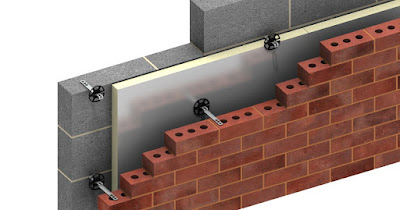
Wall ties which are sometimes referred to as brick ties are used at time of construction of the building with cavity walls. The brick ties are used for joining the two leaves of the cavity wall together and that allows the two parts to act as a homogeneous unit. The brick ties are hidden from the view of the construction. Thus, it plays an important role in ensuring the long term durability and stability of the masonry or building.

The brick ties which would be poorly installed or insufficient for the cavity walls would further lead to the extreme structural problems and that includes damp penetration, masonry wall cracks or even the collapse of the outer masonry leaf.

Here are some of the most common issues that arise with the usage of brick ties. Thus, the below article would help you in saving your masonry from collapsing. Go on and have a look!

·      Inaccurate spacing: The contractors place the Brick wall ties or brick ties wherever they find them to be convenient. This results in the attachment of the plywood or OSB sheathing. The contractors should have perfect knowledge regarding the space as in one tie per 2.67 feet of the wall area. Also the numbers can work with 16 or 24 inch of the stud spacing.

·      Poor nailing: In most of the masonries, it has been observed that the brick ties that are installed with the uncoated nails are susceptible to corrosion. While on the other hand the contractors use the roofing nails which do not penetrate the framing deeply. Thus, it is recommended that the contractors should always use at least 2.5 inch of the galvanized nail.

·    Upside-down ties: Most of the installers fasten all the ties in order to start the brick work. At that time, often the corrugated ties get folded. Thus, the ties get lined up.  And this upside-down tie can act as a spring under load. This can make the water slipping from the wall.

Wide gaps: The corrugated brick ties are only stiff enough when there’s at least 1 inch of the airspace in between. However, when the brick layers align on the top of it, it leaves 2 or 2.5 inches of the space. And even if the wall doesn’t fail, the brick then deform under wind load and this causes cracks.

Friday, 9 August 2019

Different Types of Brick Ties

 brick ties


Over the years, many different materials have been used to make brick ties. In large number of instances, the how old a properly is and its location will dictate the construction of its brick ties. Some common types are:

1 – Metal

At present, stainless steel is widely used but mild steel, copper, wrought iron and cast iron have traditionally been used. Wrought iron and cast iron brick ties are usually quite heavy, and in case of corrosion it should be removed in most cases. Copper brick ties are for the most part quite rare, but in fact they are very strong and durable.

2 – Brick or Terracotta

It is rarely and usually isolated in certain regions, says an online store that deals in brick ties. They also have several drawbacks as they create cold thermal bridges to the interior walls, allowing moisture and cold to pass through them.

3 – Stone or Slate

Once more, this is not common and has numerous drawbacks, including an inclination to breakage and cracking in the event of movement. Nevertheless, they are fairly corrosion-resistant and, if owned, where there is no sign of movement, they should last a long time. Again, however, this type of tie can transfer moisture and cold to the inner skin.

In most maximum properties dating back to the 1930s, mild steel is the element preferred for the manufacture of brick ties, and under normal circumstances, the mild steel used is left as it was (uncoated) or coated with a bitumen type material. As technology has emerged and recognition of rust and corrosion has progressed, galvanizing has become the preferred coating, providing the joints with an outer layer that is resistant to water and moisture to extend their service life.

How to Replace and Install Cavity Wall Ties

In the event that you notice visual cracks due to corrosion caused by brick ties, it may be beyond DIY. You are ought to seek help from a qualified civil engineer to assess and suggest the following steps. In this situation, corroded brick ties must be removed. This will be a highly qualified work that must be completed by a person with the abilities and experience essential to repair degraded brick ties so as not to cause additional architectural harm to property.